
“The great tragedy of Science - the slaying of a beautiful hypothesis by an ugly fact.”
- Thomas Henry Huxley, 1870
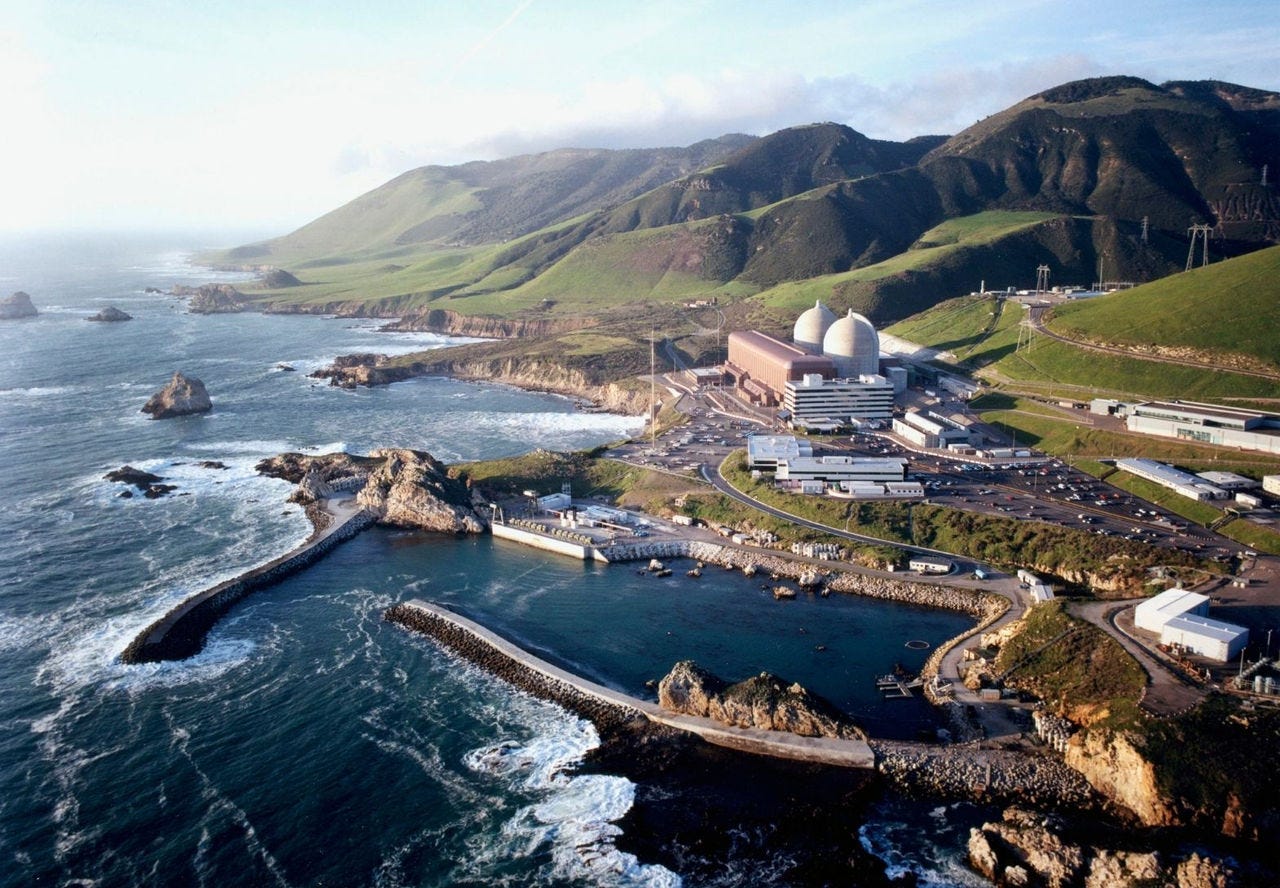
Diablo Canyon Power Plant on California’s central coast. Photo: Pacific Gas and Electric Company / Wikimedia Commons.
Stanford professor Mark Z. Jacobson recently made a remarkable claim about California’s Diablo Canyon nuclear plant.
According to Jacobson, Diablo Canyon “wasted” 29 percent of its electricity over the past year because California was forced at other times to curtail wind and solar - to turn down or shut off some wind and solar production because the grid could not use all the electricity available. During April and May, he says, the amount curtailed reached as much as 89 percent of Diablo Canyon’s output.
His conclusion: California is spending billions subsidizing an increasingly “wasteful and useless” nuclear plant while wind and solar could provide the electricity instead.
Jacobson is not a casual participant in this debate. The Stanford professor became widely known for roadmaps arguing that the United States - and eventually much of the world - could meet essentially all energy needs with wind, water and solar, without nuclear power.
He is evaluating a real-world grid through a framework he has spent much of his career developing and defending.
And there is one large problem with his argument:
The electricity being turned off wasn’t coming from Diablo Canyon. It was overwhelmingly weather-dependent generation, principally solar.
Once you look at California’s grid, Jacobson’s argument begins to turn itself inside out.
When Solar Is Curtailed, Blame Nuclear
California has built so much solar that on sunny spring afternoons the state increasingly has more electricity available than its grid can use.
The California Independent System Operator, or CAISO, operates most of California’s high-voltage electrical grid. Its job is to keep electricity supply and demand balanced from moment to moment.
Electricity is unusual. The grid cannot simply pile excess production in a warehouse and retrieve it later. When California has more electricity available than it can use, store or export, grid operators sometimes order generators to reduce production.
That is curtailment.
Put simply: the electricity could have been generated, but there was nowhere useful for it to go at that moment.
In California, the generation being curtailed is overwhelmingly weather-dependent wind and solar, principally solar.
We normally call these resources “renewables.” That describes where their energy comes from. It tells us surprisingly little about their usefulness to an electrical grid at any particular moment. The more important engineering characteristic is that their output is weather-dependent.
Solar produces when the sun shines. Wind produces when the wind blows. Neither can simply be commanded to produce more because consumers happen to need electricity.
California has reached the peculiar point where some of this supposedly precious “renewable” electricity has become disposable: when too much arrives at once, grid operators throw the opportunity to generate it away.
According to our tabulation of CAISO data, first-half wind-and-solar curtailment increased from roughly 3.0 terawatt-hours in 2025 to about 4.5 terawatt-hours in 2026 - roughly 50 percent in one year.
Yet Jacobson takes those curtailed wind-and-solar megawatt-hours, compares them with Diablo Canyon’s production, and concludes that the nuclear electricity was wasted.
Calling nuclear generation waste because the nuclear plant continued operating assumes the conclusion: solar gets priority, therefore whatever prevents additional solar production must be the waste.
California’s Duck Has a Problem
The best picture of California’s problem is its famous duck curve. You do not need to be an electrical engineer to understand it.
As California has added more solar, the amount of electricity needed from other sources plunges during sunny midday hours, creating the duck’s belly. Then the sun sets while Californians continue using electricity, and other generators and batteries must rapidly fill the gap - the duck’s steep neck.
Look at the belly. That is where California increasingly has excess electricity. Look at the neck. That is where California suddenly needs electricity again.
And if we are trying to identify the generation responsible for creating that enormous midday belly, an around-the-clock nuclear plant doesn’t exactly fit the bill.
The problem is not simply how much electricity California produces. It is when it produces it.
A unit of electricity produced at 1 p.m., when California may already have too much, is not economically or operationally equivalent to the same unit produced at 8 p.m., when solar production has disappeared. Electricity is a perishable product; its value depends partly upon when it is available.
Diablo Canyon produces during both periods. Solar doesn’t. California’s batteries increasingly charge during solar-heavy hours and discharge after sunset precisely because electricity at those two times has different values.
You don’t fix the belly of the duck by feeding it more solar.
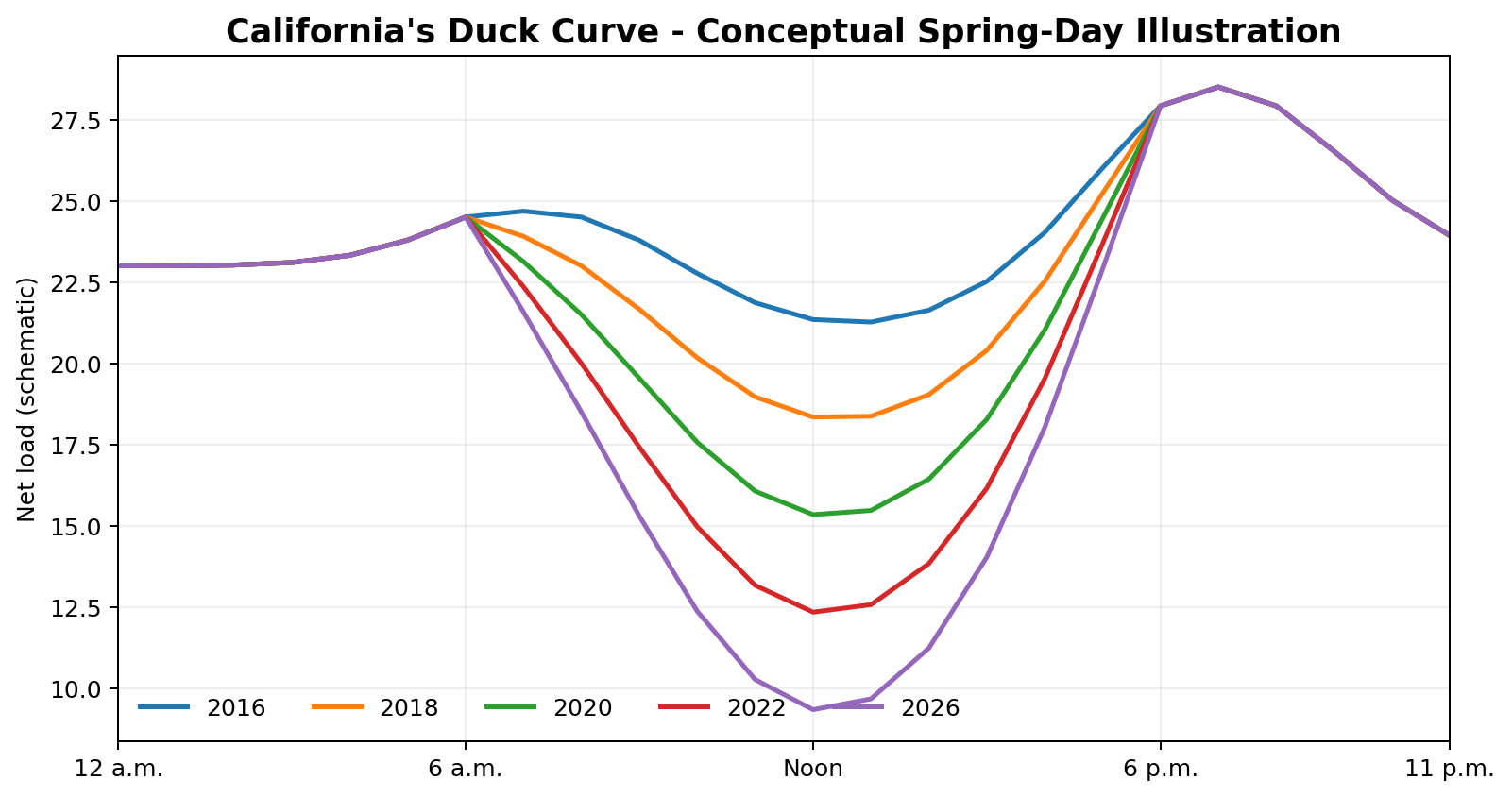
Figure 1. Conceptual illustration of California’s deepening duck curve as midday net load falls and the evening ramp steepens.
California Tried Batteries. Lots of Them.
The obvious response is: What about batteries? California has certainly tried them.
California now has nearly 17 gigawatts of battery storage, up from only about 500 megawatts in 2018.
Over roughly the period we examined, the California grid added approximately 1.9 gigawatts of utility-scale solar capacity - about a 9 percent increase - and 3.8 gigawatts of battery capacity - about a 29 percent increase.
Yet during the first half of the year, wind-and-solar curtailment increased by roughly 50 percent.
Weather, hydroelectric production, electricity demand and transmission constraints all affect curtailment. These numbers do not prove that adding solar and batteries caused the increase. Nor do they mean batteries do not work.
California’s batteries increasingly perform exactly the useful job for which they were built: absorbing midday electricity and returning some of it during the evening ramp.
But that brings us to the question that matters: what does the entire system cost?
California added substantially more solar and enormous amounts of battery storage - and its problem with excess wind and solar electricity still got worse.
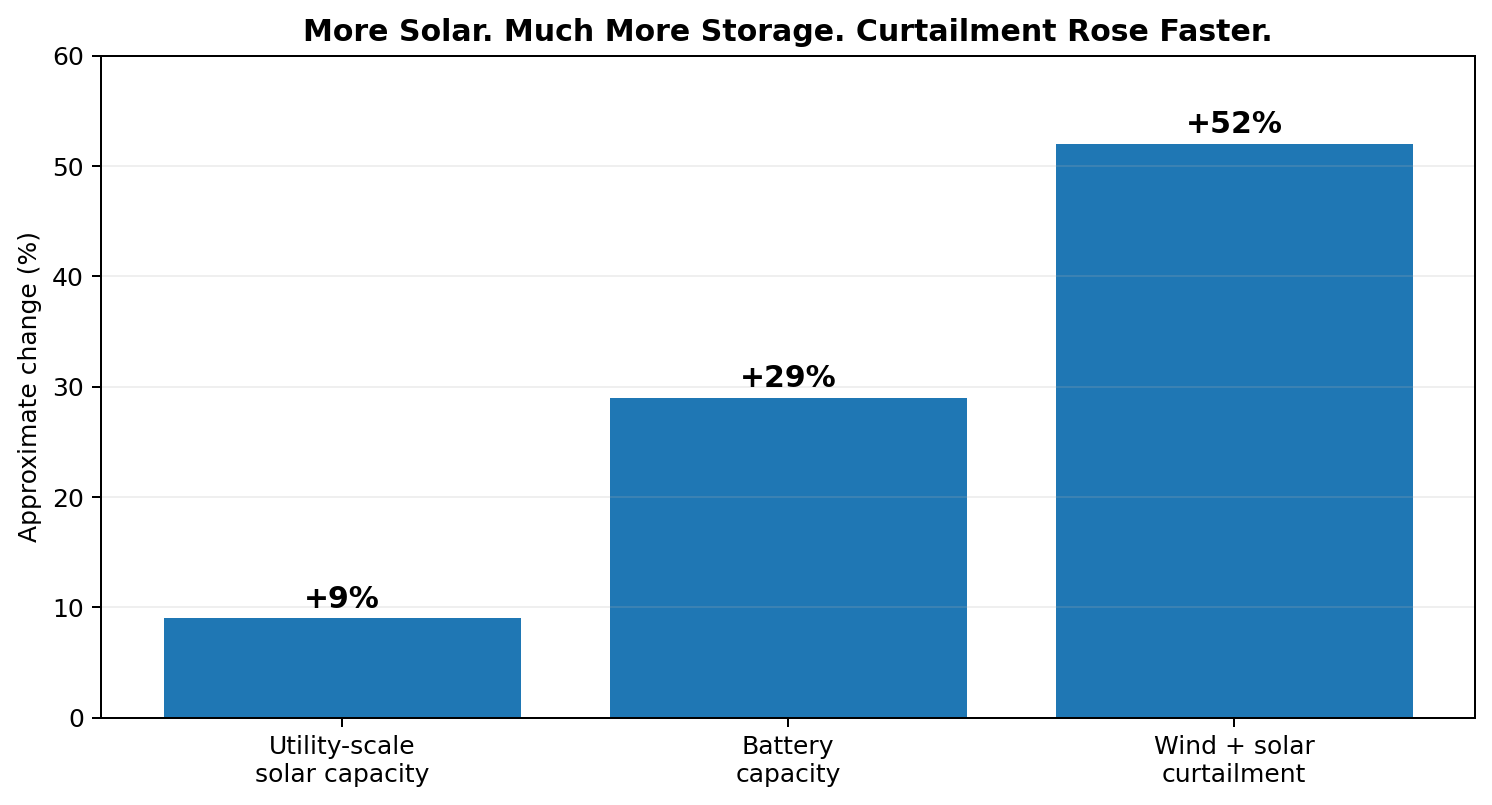
Figure 2. Approximate change over the period examined. The comparison is descriptive, not a claim of causation.
Batteries Move Electricity. They Don’t Make It.
Batteries do not generate electricity. They take electricity produced at one time, store it, lose some energy in the process, and deliver the remainder later. In effect, batteries move electricity through time.
That can be extremely useful. But it has a cost. So does the additional generation needed to cover storage losses.
California is building enormous quantities of batteries because enormous quantities of electricity increasingly arrive at times different from when customers need them. That cost belongs to the electrical system whether it appears on the solar developer’s balance sheet or somewhere else.
Four Hours Is Not Four Seasons
Then comes the problem four-hour batteries cannot solve: seasonality.
A four-hour battery can take electricity produced at 1 p.m. and deliver it at 7 p.m. It cannot take surplus electricity produced in April and save it for a difficult week in December.
Moving electricity from afternoon to evening is an hour-to-hour problem. Maintaining reliable electricity through changing weather and seasons is an energy-across-days, weeks and months problem.
California can therefore have too much solar electricity on a sunny afternoon in April while still needing dependable generation during nights, cloudy periods and other seasons. There is no contradiction.
California’s seasonal reliability portfolio is broader than batteries: hydroelectric power, imports, geothermal generation, demand response, dispatchable generation, transmission and potentially long-duration storage can all contribute. The point is simpler: four-hour batteries solve a different problem from seasonal adequacy.
Diablo Canyon also cares about seasons - but differently. Its operators can schedule refueling and major maintenance during lower-demand periods. Weather-dependent generators do not choose when their output declines.
One system plans its outages around the grid. The other makes the grid plan around its output.
A reliable electrical system must survive not merely the average day, but the wrong hour of the wrong day in the wrong season.
April and May Tell the Story
Spring is particularly revealing because California often combines mild electricity demand with abundant sunshine.
Our CAISO tabulation puts April curtailment at about 0.74 terawatt-hours in 2025 and 1.46 terawatt-hours in 2026. May rises from about 0.45 terawatt-hours to 1.45 terawatt-hours.
These are wind and solar electricity that could have been produced but wasn’t because the grid could not use all of it when it was available.
And this happened while California was adding enormous battery capacity specifically intended to move surplus electricity into other hours.
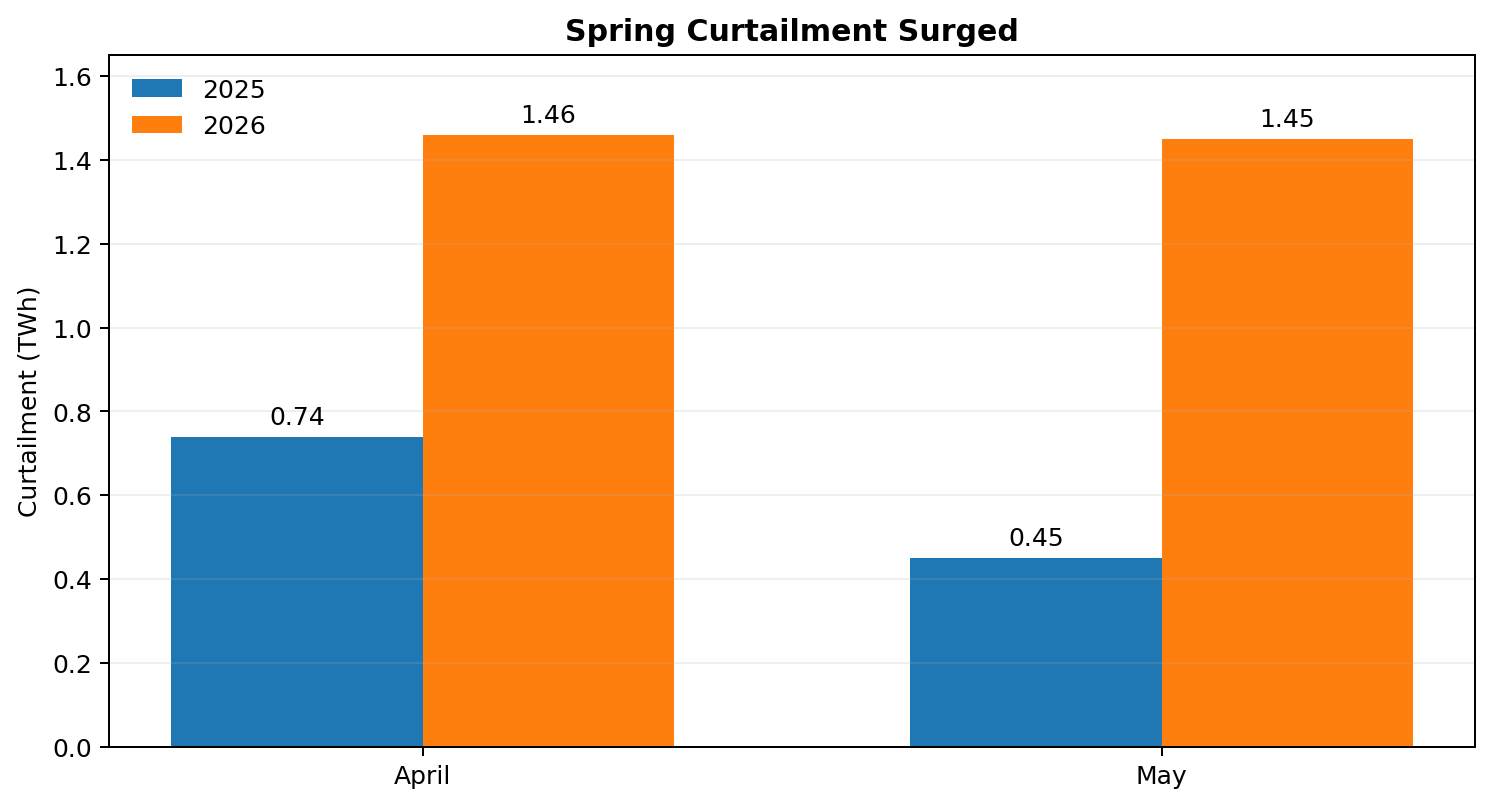
Figure 3. Wind-and-solar curtailment in April and May, 2025 versus 2026, based on the CAISO data tabulated for this article.
At what point does an engineer ask whether the problem isn’t too little storage, but too much generation arriving at the same time?
California’s Dependence Doesn’t Stop at the State Line
There is another useful measure of California’s electricity balance: imports.
In 2024, California was a net importer of about 62.2 terawatt-hours of electricity - roughly 22 percent of its total electricity mix and about 3.4 times Diablo Canyon’s annual generation.
California’s own Energy Commission says the state is a net importer particularly during evening hours, when electricity demand is highest. Its 2025 reliability assessment says about 29 percent of the state’s electricity needs are served by imported electricity, while warning that future import availability depends on transmission and on neighboring regions having power available to sell.
There is nothing inherently wrong with importing electricity. Regional trade can lower costs and improve reliability.
But voluntarily retiring roughly 18 terawatt-hours a year of dependable, in-state, low-carbon generation while remaining a major importer deserves a stronger justification than calling the plant “wasteful.”
The composition of those imports makes the comparison even more interesting. In 2024, California’s net imports included about 9.2 terawatt-hours of nuclear electricity - roughly half a Diablo Canyon’s annual output - as well as about 8.2 terawatt-hours from natural gas and 5.9 terawatt-hours from coal.
That does not mean every megawatt-hour from Diablo Canyon would otherwise be replaced by coal or gas. Electricity systems do not work that neatly. Much of California’s imported electricity is itself low-carbon wind, solar, hydro and nuclear generation.
But neither can policymakers assume that retiring dependable nuclear generation means replacing it exclusively with wind and solar. When dependable low-carbon generation disappears, something must supply electricity during the hours its proposed replacements cannot. Sometimes that something burns fuel.
California itself ultimately reached a similar reliability conclusion. After planning to close Diablo Canyon, the state reversed course and authorized continued operation through 2030. In April 2026, Governor Gavin Newsom described Diablo Canyon as providing “critical 24/7 carbon-free electricity” as California faces growing demand and hotter summers.
Apparently “useless” electricity becomes rather more useful when the grid needs it.
But That Leaves a Larger Question
If California is already curtailing increasing amounts of weather-dependent electricity, relying heavily on batteries and remaining a substantial net importer, what happens when the state deliberately builds much more of the same system?
That is where the engineering problem becomes an economic - and ultimately political - one.
In Part II: California’s planned expansion, declining marginal value, electricity prices, subsidies, land, carbon - and what happens when an energy model acquires the force of law.
Sources, Links & Attribution
• Mark Z. Jacobson Facebook post discussed in this article
• California Independent System Operator - Managing Oversupply / Curtailment
• California Energy Commission - Energy Storage System Survey
• PG&E - Diablo Canyon Power Plant
• California Energy Commission - 2024 Total System Electric Generation (imports by fuel)
• California Energy Commission - 2025 Energy Resource and Reliability Outlook
• Governor of California - Diablo Canyon license renewals, April 2, 2026
Methodology note: Curtailment comparisons show scale and system behavior, not simple one-variable causation; weather, hydro, demand, transmission and market conditions also matter.
Duck and Cover - Part I
Thank you for your article, Ed. Independent nonprofit Californians for Green Nuclear Power, Inc. (CGNP) is far too familiar with the propaganda being disseminated by Mark Z. Jacobson, Ph.D. Here is an important element of our rebuttal: "The Spanish Version of the 'Duck Curve' is a real killer - This curve underscores the problem of insufficient synchronous grid inertia in Spain on April 28, 2025," by Gene Nelson, Ph.D. 8 July 2025, GreenNUKE Substack.
https://greennuke.substack.com/p/the-spanish-version-of-the-duck-curve
The constraint is that a grid requires adequate synchronous grid inertia (SGI) in order to maintain frequency stability. The problem is that solar, wind, and batteries typically lack the ability to provide significant amounts of SGI. Generators which provide huge quantities of SGI such as Diablo Canyon Power Plant are giant flywheels which keep the lights on. I hope you will be discussing this SGI aspect in the second part of your article. CGNP's perspective is that solar, wind, and batteries produce "junk power" that destabilizes the grid. That is the reason why solar and wind are curtailed. The physical laws that CGNP describes are not subject to change by legislators who fail to understand science and engineering principles.
While I did not coin this phrase, it is applicable to the solar, wind, and batteries discussion:
"We've built an entire system around fashionable lies."
Jacobson is an idiot, useful only to the rabid anti-nuclear paymasters that fund his department at Stanford.