
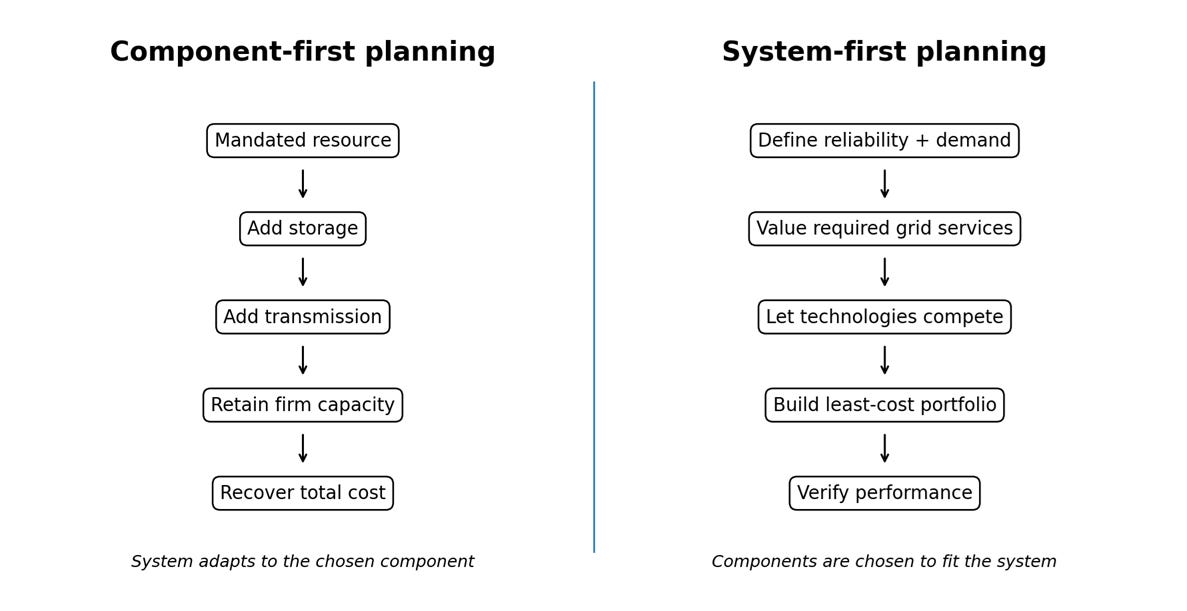
Figure 1. Two different ways to plan an electrical system. The central question in Part II is whether California selected resources to fit the system—or increasingly redesigned the system to accommodate selected resources.
Previously in Duck and Cover
Part I examined Mark Z. Jacobson’s claim that growing wind-and-solar curtailment makes Diablo Canyon increasingly “wasteful and useless.” The operating data showed something different: California is already curtailing large amounts of weather-dependent generation, relying heavily on batteries and imports, and depending on firm resources when solar production disappears.
Part I ended with a larger question: if California is already experiencing those system effects, what happens as the state deliberately builds much more weather-dependent generation and storage?
Part II begins there—not by repeating the duck curve, curtailment or battery data, but by asking whether California is designing an electrical system or assembling a collection of favored components.
Design the system first. Select the components second.
The Plant California Already Had
Kenneth Kaminski spent 36 years at Diablo Canyon in maintenance, engineering and operations, ultimately serving as a Senior Reactor Operator. In a recent Substack essay, Why Diablo Canyon Never Became a Load-Following Plant, he offers an operator’s view of a question that is often treated too casually from outside the plant: why not simply turn nuclear output down whenever solar production is abundant?
Diablo Canyon could reduce power. It did so for maintenance, testing and grid conditions. But occasional power reductions are not the same thing as designing a plant to ramp up and down every day.
Kaminski recalls arriving for a shift when a unit had been reduced to roughly half power for intake work. Before seeing an instrument, he knew the unit was at reduced power because the plant sounded different. It remained safe and within operating limits; his point was that the entire machine was operating away from the stable full-power condition for which it had been optimized.
Diablo Canyon was designed, analyzed, licensed and operated primarily as a baseload station. At steady full power, temperatures, pressures, steam flows, valves and control systems settle into comparatively stable conditions. Repeated power changes introduce additional thermal and pressure transients, equipment movement, chemistry changes, xenon management and operator workload.
None of this means nuclear plants cannot load-follow. Some do. Newer designs can incorporate greater maneuverability from the beginning. The relevant lesson is not that nuclear is incapable of changing power.
The relevant lesson is that a generating plant is designed for a role within a system.
Diablo Canyon was exceptionally good at the job California originally built it to perform: produce large quantities of dependable electricity continuously for long periods.
Then California changed the system around it.
When the System Changes Around the Plant
As California added large amounts of solar, the operating requirements imposed on the rest of the grid changed. Midday energy became abundant. Flexibility became more valuable. Storage, transmission, exports, curtailment and dispatchable generation became increasingly important companions to the new resource mix.
From the grid operator’s perspective, asking Diablo Canyon to reduce output during solar-rich hours may appear useful. From the plant’s perspective, however, California is asking an asset designed for steady operation to perform a different mission so that later-added resources can receive priority.
There is an economic consequence too. Reducing Diablo Canyon’s output does not eliminate most of Diablo Canyon’s costs. The plant remains staffed, maintained, secured and licensed. Its fixed costs remain. It simply produces fewer megawatt-hours across which those costs can be spread.
That leads to a broader principle that applies to solar, nuclear, gas, wind, storage and every other resource:
A well-designed generating resource does not necessarily produce a well-designed electrical system.
Individual resources can perform exactly as intended while the combined portfolio becomes more expensive, more complicated or less reliable than another possible design.
That is why the order matters. First determine what the electrical system must accomplish. Then choose the resources that accomplish those jobs at the lowest total cost consistent with reliability, environmental objectives and other public priorities.
The Next Solar Panel Is Worth Less Than the Last One
This brings us to marginal value. The concept is simple: the value of another unit of something depends partly on how much of it you already have.
The first increments of California solar displaced valuable daytime generation. But each additional solar installation produces during substantially the same daylight hours as the solar already on the system.
As penetration rises, the next increment increasingly competes with the output of the resources that came before it. Its market value can decline even if the technology itself becomes cheaper. Eventually additional output must be stored, exported, shifted into new demand or curtailed.
That is why the important economic question is no longer simply how cheaply another solar plant can produce a megawatt-hour. It is what the next megawatt-hour is worth to the system at the time it arrives.
Kaminski’s account adds another dimension. If the next solar megawatt-hour causes an existing low-marginal-cost plant to reduce output, the value of the new generation must be assessed against what it displaced and what additional system costs are required to accommodate it.
The marginal solar panel is not the average solar panel.
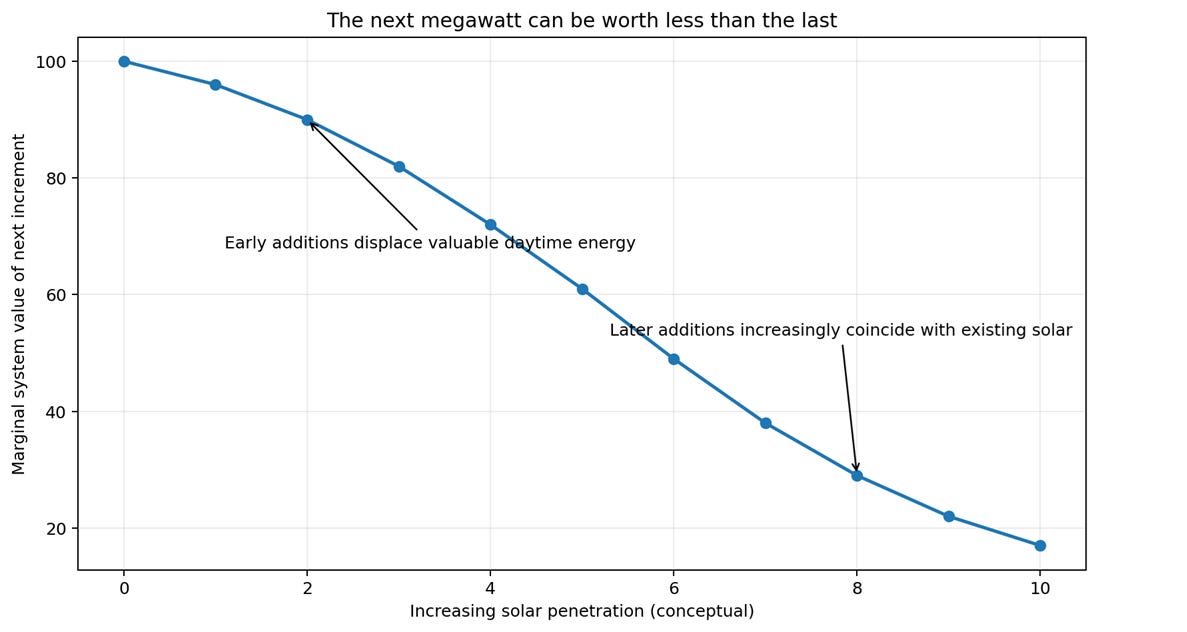
Figure 2. Conceptual illustration of declining marginal system value as additional solar increasingly arrives during hours already well supplied by existing solar. This is an explanatory schematic, not an empirical estimate of California prices.
And California Is Nowhere Near Finished
This is what makes the next stage important. California is not approaching the end of its buildout. It is planning a much larger version of the system it already has.
California currently has nearly 17 gigawatts of battery storage. The state projects that approximately 52 gigawatts will be needed by 2045—roughly three times today’s capacity.
A California Energy Commission project report puts the broader scale even more starkly: meeting the state’s 2045 goals is projected to require approximately 79 gigawatts of new renewable generation and 52 gigawatts of battery storage.
Since 2020, California electricity providers have developed more than 27 gigawatts of new clean-energy supply and contracted for another 22 gigawatts by 2030. In February 2026, the CPUC ordered another 6 gigawatts of new clean-energy and storage qualifying capacity for 2029–2032.
The question is not whether California can physically build those resources. It almost certainly can.
The question is whether they are the components an optimally designed California electrical system actually needs at the margin—and whether the alternatives were allowed to compete on equal terms.
Cheap Generation Is Not a Cheap Electrical System
We have all seen familiar comparisons showing solar at one cost per megawatt-hour, wind at another and nuclear or gas at another. These comparisons often rely on levelized cost of electricity, or LCOE: the estimated lifetime cost of producing electricity from a generating facility.
LCOE is useful information. But it is not a complete description of an electrical system.
Consumers do not merely need annual megawatt-hours. They need dependable electricity when they demand it. The system must also provide capacity, reserves, ramping capability, transmission, voltage support, frequency control and seasonal adequacy.
A resource may supply some of those services extraordinarily well and others poorly. That is not an indictment of the resource. It is an engineering characteristic the system must account for.
Once a resource requires complementary storage, transmission, firm capacity or other grid services, those costs belong in the system calculation even if they appear on a different spreadsheet.
A cheap source of electricity does not necessarily produce a cheap electrical system.
If It’s So Cheap, Why Is the Electricity So Expensive?
California gives us an opportunity to test that proposition against the real world. According to the U.S. Energy Information Administration, California’s average residential electricity price in 2024 was 31.97 cents per kilowatt-hour, versus a national residential average of roughly 16.5 cents.
California’s high electricity prices cannot simply be laid at the feet of solar panels. Wildfire mitigation, transmission and distribution spending, utility infrastructure, regulatory policy, rooftop-solar cost shifting and other factors contribute.
But that is precisely the point: the customer pays for the system.
The customer does not receive separate bills labeled cheap solar generation, storage, transmission expansion, wildfire hardening, distribution, reliability and policy costs. The customer receives one electricity bill.
So low LCOE for one component cannot settle the affordability question for the whole grid.
Cheap generation is interesting. Cheap electricity is what the customer was promised.
Electricity Has a Physical Footprint
Simple cost-per-unit comparisons also omit another scarce resource: land.
Diablo Canyon’s two reactors produce roughly 18 terawatt-hours of low-carbon electricity annually from a power-plant site of approximately 1,000 acres.
Nuclear concentrates enormous electricity production on a relatively compact industrial site. Weather-dependent generation spreads energy collection across larger areas. Solar requires panels, roads, collection wiring, substations and interconnections. Wind spreads turbines, roads and collection systems across still larger areas, although much of the land between turbines can remain available for other uses. Transmission then connects geographically dispersed resources with consumers.
This does not mean every acre occupied by energy infrastructure is environmentally destroyed. It means acreage is part of the system.
Count it.
About Those Nuclear Subsidies…
Jacobson puts government and ratepayer support for continued Diablo Canyon operation at approximately $3.2 billion. Fair enough. Government support deserves scrutiny. So count it consistently.
The federal government finalized terms for up to $1.1 billion in Civil Nuclear Credit support for Diablo Canyon.
California’s Public Advocates Office estimated that legacy rooftop net metering imposed an approximately $8.5 billion annual cost shift onto customers without rooftop solar by the end of 2024. A later utility estimate reported by the CPUC put the 2024 cost shift closer to $7 billion.
A cost shift is not identical to a taxpayer subsidy. But it is money one group of electricity customers must recover because another group pays less toward the costs of the electrical system. Federal tax credits, state incentives and other support exist in addition.
So if subsidies are evidence against Diablo Canyon, apply the same accounting rules to every resource.
Count all the support. Then divide it by useful electricity delivered. And apply the same rules to everybody.
The Solar Panel Isn’t the System
This is the accounting mistake running through much of the debate. California does not merely need electricity. It needs an electrical system.
The relevant comparison is not one generator against another in isolation. It is the total portfolio necessary to deliver dependable electricity: generation, storage, transmission, reserves, balancing, curtailment and whatever firm resources remain necessary.
Those costs do not disappear because we put them in different columns.
And there is another question that should be asked every time a new resource is added: what existing assets does it allow the system to stop paying for?
If another gigawatt of solar allows a gigawatt of firm generation or other infrastructure to be avoided, count that benefit. If the system adds a gigawatt of solar but still needs essentially the same firm capacity for evenings, winter conditions or extended unfavorable weather, count that too.
The relevant question is not simply what we added. It is what the addition allowed the system to eliminate.
Count the whole system.
And the Carbon Isn’t Zero Either
Wind and solar have no direct carbon dioxide emissions while generating electricity. But zero operating emissions and zero lifecycle emissions are not the same thing.
Solar panels require mining, refining, manufacturing, transportation, mounting structures and inverters. Wind turbines require steel, concrete, composites and copper. Batteries require minerals, processing, manufacturing and eventual replacement. Transmission requires steel, aluminum, concrete and construction. All carry embedded carbon emissions.
Nuclear has lifecycle emissions too. But here the relevant comparison is not new nuclear versus new solar. Diablo Canyon is already built. Its concrete was poured, its steel manufactured and its reactors constructed decades ago.
The relevant carbon question is what must now be manufactured and built to replace or displace the useful service of an existing asset—and how much of the resulting output customers can actually use.
Carbon accounting doesn’t stop at the power-plant fence.
When the Ducks Come Home to Roost
Part I showed the operating consequences of California’s existing resource mix. Part II asks whether doubling down on the same architecture is the best response.
California plans tens of gigawatts of additional clean generation and storage while its customers already pay some of the highest electricity prices in the country.
Jacobson’s diagnosis remains that Diablo Canyon is increasingly wasteful because its steady output prevents still more weather-dependent generation from being used during surplus hours.
Kaminski’s account suggests a different interpretation. The issue may not be that California selected a “bad” resource. Solar can perform the job solar was designed to perform extremely well. Diablo Canyon performs its intended job extremely well. Batteries can do the same.
The problem arises when individually successful components do not add up to an economically optimized system.
Design the system first. Select the components second.
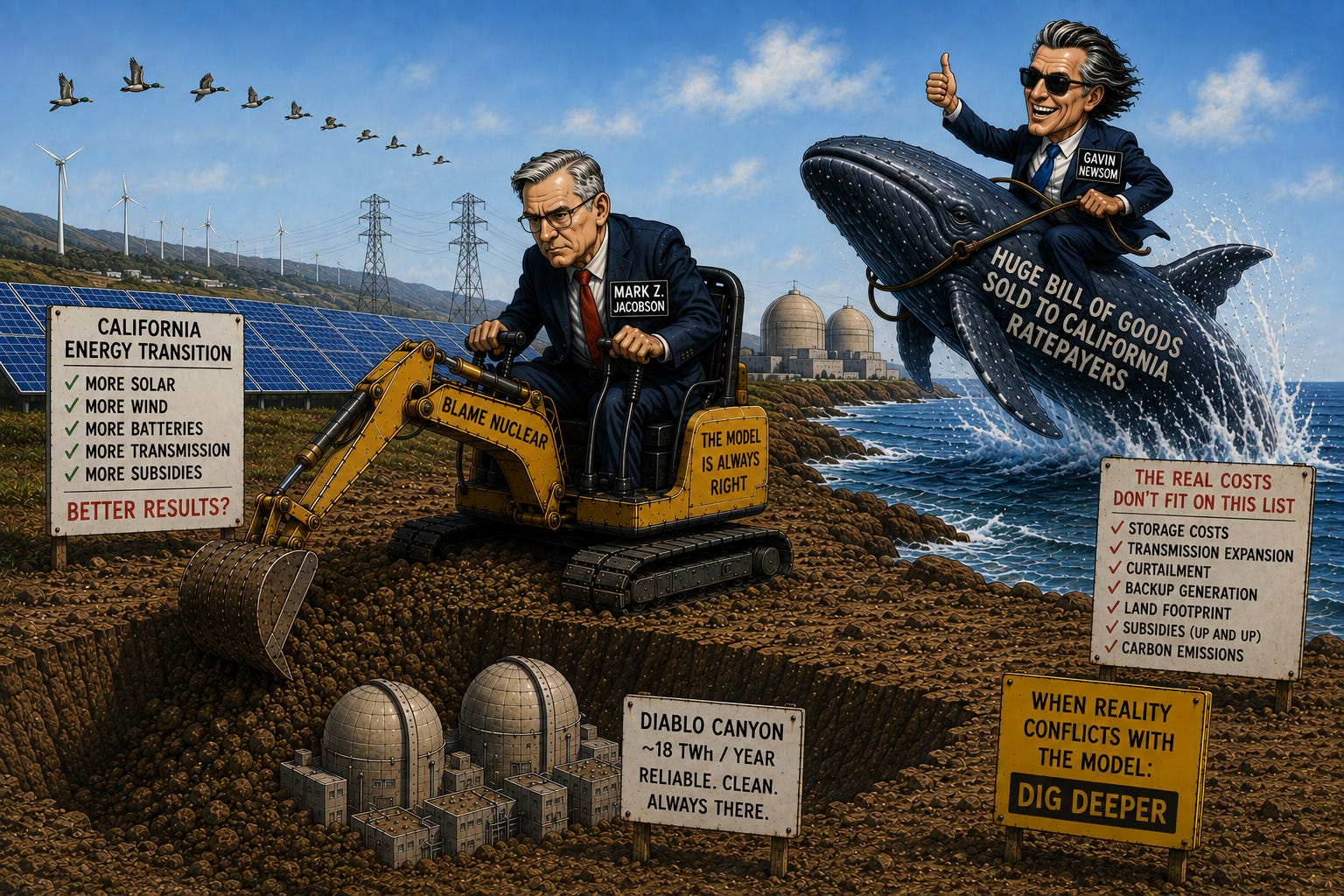
Figure 3. Editorial cartoon created for this article. Satire directed at the policy logic and accounting questions discussed in the text.
When a Model Acquires the Force of Law
This is where the issue becomes larger than Mark Jacobson.
There is a useful term for what happens when people invest careers, reputations and years of intellectual effort in an idea: sunk intellectual capital.
Something more consequential happens when that idea becomes government policy.
California did not arrive at its present electricity system because millions of consumers independently chose this particular generation mix. Government policy helped choose the destination—and increasingly, some of the components.
By 2030, California requires 60 percent of retail electricity sales to come from qualifying renewable resources. The requirements then rise to 90 percent renewable or zero-carbon electricity by 2035, 95 percent by 2040, and 100 percent by 2045.
Notice the language: renewable or zero-carbon.
That distinction matters. California itself counts nuclear electricity among its zero-carbon clean generation. In 2024, the California Energy Commission reported that 67 percent of retail electricity sales came from clean sources: 45.2 percent renewables, 10.8 percent large hydro, and 11.1 percent nuclear.
In other words, Diablo Canyon is not an obstacle to California’s ultimate statutory objective. It is already producing the kind of electricity California says it wants in 2045.
So here is a remarkably simple question: if the destination is zero-carbon electricity, why discard an already-built plant producing roughly 18 terawatt-hours of dependable low-carbon electricity every year while simultaneously constructing enormous quantities of new generation, batteries and transmission to reach the same destination?
Mandates favored particular generation. Tax preferences and subsidies encouraged particular investments. Policy decisions encouraged retirement of other resources. Rate structures shifted costs among consumers. Taxpayers and ratepayers financed the storage, transmission and other infrastructure increasingly necessary to accommodate the resulting system.
Each new intervention can become the justification for the next. That is no longer merely an engineering problem. It is a political feedback loop.
Unlike an academic model, a government mandate has coercive power. Ratepayers cannot decline the experiment. Businesses cannot choose another California electrical grid. Taxpayers cannot check the “no thank you” box. They receive the bill.
So the proper test is not whether California installed another mandated gigawatt of favored generation. It is whether the resulting system is more reliable, more affordable, more abundant and genuinely lower-carbon once the entire system is counted.
Did California design the electrical system it wanted and then select the resources best suited to build it—or did it select favored resources first and then redesign the electrical system around them?
Changing course becomes difficult after careers, agencies, industries, regulations and political reputations accumulate around the original premise.
Sunk intellectual capital becomes sunk political capital.
Count the Whole System
Which brings us back to Jacobson.
Weather-dependent electricity gets curtailed? Blame nuclear. Midday oversupply? Build batteries. The batteries cost billions? Put that in another column. Four-hour batteries do not solve seasonality? Build something else for that. Transmission cannot keep up? Build more transmission. The land footprint grows? Another column. California remains a major net importer—including nuclear, gas and coal generation? Another column. Electricity rates approach twice the national average? Do not confuse generation cost with your electric bill. Production does not match demand? Create new demand.
Then separate all those costs from the solar panel and tell consumers once again how cheap renewable electricity is.
Meanwhile an already-built nuclear plant produces electricity through noon, sunset, midnight and sunrise—and schedules its planned outages around the needs of the grid. California itself counts that electricity toward its zero-carbon future.
And somehow, that’s the problem.
Good engineering uses models. Good markets expose mistakes. Good government must be willing to admit them.
When reality contradicts a policy, the answer cannot always be another mandate designed to make reality conform to the policy. Sometimes you stop. Measure. Reconsider. Change course.
Count the cost.
Count the subsidies.
Count the storage.
Count the transmission.
Count the land.
Count the carbon.
Count the electricity that actually reaches customers when they need it.
And count the bill.
Count the whole system.
Because when reliable, round-the-clock electricity must be redefined as waste to preserve the model—and consumers must finance everything necessary to preserve that model—perhaps the problem isn’t Diablo Canyon.
Perhaps it’s the model, the mandates built around it, and our unwillingness to admit when either has failed.
Sources, Links & Attribution
• Kenneth Kaminski — “Why Diablo Canyon Never
Became a Load-Following Plant,” Substack, July 26, 2026. Personal recollections and perspective of a retired Diablo Canyon Senior Reactor Operator.
• California ISO — Today’s Outlook / Supply
• California Energy Commission — Clean Energy Serving California
• California Energy Commission — Energy Storage System Survey
• California Public Utilities Commission — Renewable Portfolio Standard
• California Public Advocates Office — NEM Cost Shift Methodology Fact Sheet
• U.S. Energy Information Administration — Electricity data
• U.S. Department of Energy — Civil Nuclear Credit Program
• PG&E — Diablo Canyon Power Plant
• California Energy Commission — 2024 Total System Electric Generation
• California Energy Commission — California Energy Resource and Reliability Outlook 2025
Methodology note: Part I established the curtailment, battery, seasonality and import evidence. Part II intentionally does not repeat those analyses. It uses them as background for a separate question: whether California’s resource additions reflect integrated system design. The marginal-value figure in this document is conceptual, not an empirical estimate. Kenneth Kaminski’s discussion is cited as an experienced operator’s personal perspective and does not represent an official position of PG&E, Westinghouse or the Nuclear Regulatory Commission.
Thank you for your comments. A power system designed around nuclear power generation becomes less expensive over time. France already provides clear evidence of this trend.
A power system designed around solar, wind, and batteries becomes more expensive as the penetration increases. California provides clear evidence of this problem. Furthermore, Spain shows the system collapses when there is inadequate nuclear power like at mid-day on Monday, 28 April 2025. The adverse consequence of that system collapse was that at least eleven people depending on reliable electric power died. The economic costs connected with lost productivity and damaged production equipment are denominated in the equivalent of billions of U.S. dollars. This leads to a final question: When to halt the failed California experiment with solar, wind, and batteries?
As an intervenor before the CPUC, Californians for Green Nuclear Power (CGNP) has argued such a halt is long overdue. Please see the GreenNUKE Substack at https://greennuke.substack.com/ for details. Regrettably, CGNP has had a huge economic cost imposed on it by CPUC insistence on their dogmatic opposition to Diablo Canyon's extended operations.
This comment is by Eric Jelinski, a nuclear, mechanical, chemical engineer in Ontario, Canada. It was sent to me by email.
———————————————————-
Hi John, I read your Duck emails…it is about fanatics ducking reality.
Nuclear is designed for base load, not load following. The nuclear physics issue is Xenon transients. A power reduction causes Xenon increase. Xenon absorbs neutrons. The Xenon cycle is about 40 hours. But then to raise power 12 hours later requires additional reactivity via removal of neutron absorbing adjuster rods to increase reactivity, to increase power. And/or to dump steam when power is not needed.
All this results in all kinds of stresses, chemical, mechanical, electrical, civil that reduces the overall lifecycle. In addition, this cycling wastes fuel.
Backup using fossil fuel has similar stresses and inefficiencies.
Solar and wind are not free.
All materials for a solar system or wind system, iron for steel, Calcium for concrete, bauxite for aluminium are mined from the ground, refined, manufactured, assembled, has a larger unit cost, and has a limited life less than a reactor that may run baseload for 50 to 60 years.
One solution is to use baseload nuclear to generate electrolytic hydrogen that then feeds fuel cells producing electricity to accommodate power swings.
But we are not there yet, because wasting power is cheaper than doing a better system design.
Eric
Eric Jelinski M. Eng. P. Eng.
Retired Nuclear Engineer
Stayner Ontario
mailto:eric_jelinski@sympatico.ca
https://www.linkedin.com/in/eric-jelinski-5157a212/?originalSubdomain=ca